←
Post

Discussion
THE 30-DAY SYSTEM THAT KILLED "WINNING PRODUCTS"
If you are still trying to find a "hidden" winning product...
You are already late.
After going through multiple datasets, transcripts, and real stores doing $100K to $300K a month, one thing becomes incredibly clear:
👉 The product is no longer the edge.
The real edge is:
— how fast you spot it
— how fast you launch it
— how aggressively you push it
WHAT ACTUALLY CHANGED IN 2026
Most people are still playing this outdated game:
Find a unique product → run ads → hope it works.
But the operators doing real numbers are running something very different. They operate:
👉 A 30-day ecosystem.
Organic → Paid → Search → Geo-expansion → Bundling → Repeat.
This is what actually drives consistent 6-figure months now. Here are the 20 rules the top 1% are using to scale.
PHASE 1: THE ORGANIC PIPELINE (ATTENTION OVER UTILITY)
They are random, weird, and unnecessary.
Why? Because they do one thing extremely well...
👉 They stop the scroll.
Would a stranger say "what the hell is that?" in 2 seconds?
If yes → it has distribution potential.
If no → it dies quietly.
Product A → 5% conversion, 1M views
Product B → 1% conversion, 50M views
👉 Distribution beats efficiency.
Most people post 2 videos and conclude "the product doesn't work."
PHASE 2: AD ARBITRAGE (WHERE THE MONEY IS MADE)
👉 If you are not running Google Search ads, you are letting competitors pay for your customers.
On Google, $100 to $400 products convert easily.
TikTok is for entertainment. Google is for buying.
But some ads start the buyer journey, while others close it.
👉 Turn off the wrong top-of-funnel ad, and your entire funnel weakens.
It means the product is proven to convert.
The real question is: are you advertising where everyone is, or where they are not?
Translate the winning creatives.
Launch it in the EU or Australia.
👉 The exact same product becomes a brand new winner.
PHASE 3: STORE ENGINEERING
Most stores use a basic template and copied descriptions.
👉 Same product, drastically different conversion rate.
How? Branding, perceived value, and interest-free payment plans.
👉 You are selling perception, not cost.
Most dropshippers sell 1 unit.
👉 Selling single units is exactly why scaling fails.
The worst products look obviously cheap.
👉 Perceived cost puts a hard cap on your pricing.
PHASE 4: OPERATIONS (WHERE WINNERS DIE)
But slow shipping and poor quality lead to refunds, chargebacks, and gateway shutdowns.
👉 Operations dictate your longevity.
The winner is who launches first, who tests fastest, and who iterates the quickest.
👉 Operating without this data is just guessing.
👉 A new angle always beats a new product.
CLOSING
You don't just "find" winning products anymore.
You enter existing demand...
👉 and out-execute everyone already there.
If you are still trying to find a "hidden" winning product...
You are already late.
After going through multiple datasets, transcripts, and real stores doing $100K to $300K a month, one thing becomes incredibly clear:
👉 The product is no longer the edge.
The real edge is:
— how fast you spot it
— how fast you launch it
— how aggressively you push it
WHAT ACTUALLY CHANGED IN 2026
Most people are still playing this outdated game:
Find a unique product → run ads → hope it works.
But the operators doing real numbers are running something very different. They operate:
👉 A 30-day ecosystem.
Organic → Paid → Search → Geo-expansion → Bundling → Repeat.
This is what actually drives consistent 6-figure months now. Here are the 20 rules the top 1% are using to scale.
PHASE 1: THE ORGANIC PIPELINE (ATTENTION OVER UTILITY)
- "Stupid" products outperform "useful" ones
They are random, weird, and unnecessary.
Why? Because they do one thing extremely well...
👉 They stop the scroll.
- The real KPI is NOT conversion
Would a stranger say "what the hell is that?" in 2 seconds?
If yes → it has distribution potential.
If no → it dies quietly.
- High virality beats high conversion
Product A → 5% conversion, 1M views
Product B → 1% conversion, 50M views
👉 Distribution beats efficiency.
- Organic is now a volume game
Most people post 2 videos and conclude "the product doesn't work."
PHASE 2: AD ARBITRAGE (WHERE THE MONEY IS MADE)
- Meta educates. Google converts.
👉 If you are not running Google Search ads, you are letting competitors pay for your customers.
- High-ticket works better on search
On Google, $100 to $400 products convert easily.
TikTok is for entertainment. Google is for buying.
- The biggest silent killer is turning off ads too early
But some ads start the buyer journey, while others close it.
👉 Turn off the wrong top-of-funnel ad, and your entire funnel weakens.
- "Saturated" is completely misunderstood
It means the product is proven to convert.
The real question is: are you advertising where everyone is, or where they are not?
- Geo-arbitrage is still a massive cheat code
Translate the winning creatives.
Launch it in the EU or Australia.
👉 The exact same product becomes a brand new winner.
PHASE 3: STORE ENGINEERING
- Your product page does more work than your ads
Most stores use a basic template and copied descriptions.
👉 Same product, drastically different conversion rate.
- Pricing is pure psychology
How? Branding, perceived value, and interest-free payment plans.
👉 You are selling perception, not cost.
- Bundling is no longer optional
Most dropshippers sell 1 unit.
👉 Selling single units is exactly why scaling fails.
- If customers can guess your cost, you lose
The worst products look obviously cheap.
👉 Perceived cost puts a hard cap on your pricing.
- Fake authority kills conversions
PHASE 4: OPERATIONS (WHERE WINNERS DIE)
- Supply chain kills more stores than bad ads
But slow shipping and poor quality lead to refunds, chargebacks, and gateway shutdowns.
👉 Operations dictate your longevity.
- Margin is your survival oxygen
- Speed is the ultimate moat
The winner is who launches first, who tests fastest, and who iterates the quickest.
- Competitor tracking is mandatory
👉 Operating without this data is just guessing.
- Most winners are not "new" products
👉 A new angle always beats a new product.
- The biggest paradigm shift
CLOSING
You don't just "find" winning products anymore.
You enter existing demand...
👉 and out-execute everyone already there.
1:17 PM · Apr 19, 2026
0
0
In review
Want to join the conversation? Sign in to reply.
Discover Posts
Discussion
🧠 Shopify just flipped a switch… and most dropshippers didn’t notice
On March 24, something quietly happened.
No announcement hype.
No “new feature” buzz.
But it may matter more than any ad strategy you’re running right now.
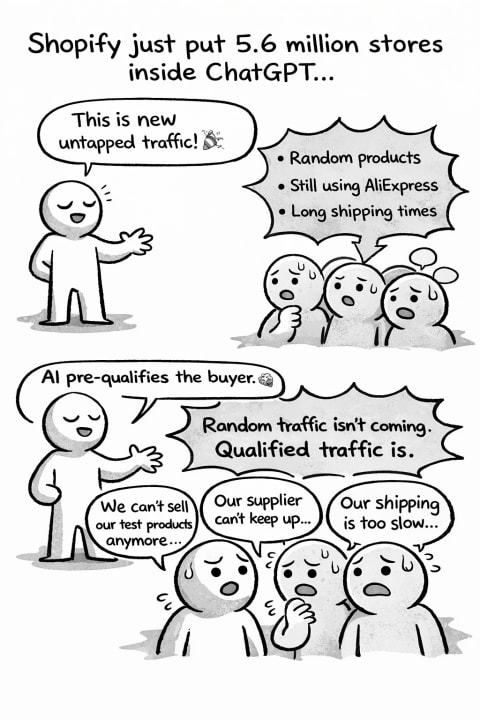
⚠️ 5.6 million stores just became “AI-native”
Shopify didn’t ask for permission.
They turned on Agentic Storefronts by default.
That means:
👉 Your store is already being surfaced inside AI
👉 Your products are already being recommended
👉 You are
On March 24, something quietly happened.
No announcement hype.
No “new feature” buzz.
But it may matter more than any ad strategy you’re running right now.
⚠️ 5.6 million stores just became “AI-native”
Shopify didn’t ask for permission.
They turned on Agentic Storefronts by default.
That means:
👉 Your store is already being surfaced inside AI
👉 Your products are already being recommended
👉 You are
🧠 Shopify just flipped a switch… and most dropshippers didn’t notice
On March 24, something quietly happened.
No announcement hype.
No “new feature” buzz.
But it may matter more than any ad strategy you’re running right now.
⚠️ 5.6 million stores just became “AI-native”
Shopify didn’t ask for permission.
They turned on Agentic Storefronts by default.
That means:
👉 Your store is already being surfaced inside AI
👉 Your products are already being recommended
👉 You are already competing there
Whether you prepared for it or not.
The shift most people are missing
This is not “another traffic channel”.
This is:
Discovery moving outside your store completely.
Before:
— Customer sees ad → clicks → lands on your product page
Now:
— Customer asks AI → AI chooses product → sends them to checkout
👉 Your product page is no longer the first impression
👉 Your data is
🧠 The uncomfortable truth
You are no longer competing as a store.
You are competing as:
— a data point
— inside a cluster
— inside a machine decision
Because Shopify Catalog:
— groups identical products
— compares sellers
— normalises listings
👉 Your product is not “yours” anymore
👉 It’s one option among many in an AI decision layer
🚨 Where dropshippers are actually exposed (this part is critical)
1) Inventory risk just went exponential
Before:
— Bad stock = a few angry customers
Now:
— AI recommends your product → thousands of people see it instantly
👉 If your supplier is slow or inaccurate:
— you can oversell at scale
— you can destroy your reviews overnight
One viral AI recommendation can break your entire backend.
2) Your “test products” are now liabilities
Most stores:
— dozens of random SKUs
— half-tested
— unclear positioning
AI doesn’t care.
It will surface them anyway.
👉 Meaning:
— your weakest products = highest risk exposure
— your catalog tail = your biggest vulnerability
3) You cannot hide from AI discovery
You can:
— disable checkout
— hide some products
But you cannot:
— fully opt out of being seen
👉 AI is now behaving like Google, not like a platform you can ignore
4) Bad data is worse than no data
AI reads:
— your title
— your description
— your structured data
Then decides:
— what your product is
— who it is for
— whether to recommend it
👉 If your listing is weak:
— AI will mis-sell your product
— conversions drop
— returns go up
🧠 The biggest insight (almost no one is talking about this)
AI traffic converts differently.
— AI traffic grew 7x
— AI orders grew 11x
👉 Orders grow faster than traffic
Why?
Because:
— AI pre-qualifies the buyer before they even click
Translation for dropshippers:
You don’t get:
— curiosity clicks
You get:
— expectation-driven buyers
Which means:
— your product must match expectation exactly
— your fulfillment must match promise exactly
⚠️ Where most dropshippers will fail
1) Still writing listings for humans
— short descriptions
— vague titles
— no structured data
👉 AI won’t understand your product properly
2) Treating this like “free traffic”
Yes, no 4% fee anymore.
But:
— competition exploded overnight
— 5.6 million stores entered instantly
👉 This is not early-stage arbitrage
👉 This is instant saturation
3) Ignoring fulfillment speed
AI buyers:
— convert faster
— expect faster delivery
If your model is:
— 10–15 day shipping from China
👉 You will get:
— worse reviews
— harsher expectations
— faster churn
4) Not controlling your catalog
Most dropshippers:
— upload everything
— test everything
Now:
— everything can be shown
👉 You need to curate what AI is allowed to see
🧩 What smart operators will do immediately
1) Clean your catalog
— remove weak SKUs
— hide unstable products
— focus on proven items
2) Rewrite titles for AI queries
Bad:
— “Blue Shirt XL”
Good:
— “Breathable cotton gym shirt for humid weather (men XL)”
👉 Think like a search query, not a product name
3) Fix descriptions
Your description should:
— explain use case
— handle objections
— define who it’s for
Because:
— AI uses it to sell for you
4) Tighten inventory buffers
Especially if:
— supplier latency is high
— stock updates are slow
👉 Inventory accuracy is now a growth lever, not ops detail
5) Align logistics with expectation
If AI drives:
— faster decision-making
You need:
— faster fulfillment
OR
— clearer delivery expectations
🔥 The real connection (this ties everything together)
Look at what’s happening at the same time:
— Amazon moving inventory upstream into China
— JD building global logistics infrastructure
— Shopify pushing AI-driven discovery
👉 These are not separate trends.
They are converging into one system:
— AI decides demand
— Logistics fulfills instantly
— Data determines who wins
Final thought
Dropshippers used to win by:
— finding products early
— running ads faster
Now?
You win by being the product AI chooses.
And AI doesn’t choose based on:
— hype
— luck
— “winning product” lists
It chooses based on:
— data clarity
— fulfillment reliability
— consistency
Most people will realise this too late.
The ones who move now will look “lucky” later.
On March 24, something quietly happened.
No announcement hype.
No “new feature” buzz.
But it may matter more than any ad strategy you’re running right now.
⚠️ 5.6 million stores just became “AI-native”
Shopify didn’t ask for permission.
They turned on Agentic Storefronts by default.
That means:
👉 Your store is already being surfaced inside AI
👉 Your products are already being recommended
👉 You are already competing there
Whether you prepared for it or not.
The shift most people are missing
This is not “another traffic channel”.
This is:
Discovery moving outside your store completely.
Before:
— Customer sees ad → clicks → lands on your product page
Now:
— Customer asks AI → AI chooses product → sends them to checkout
👉 Your product page is no longer the first impression
👉 Your data is
🧠 The uncomfortable truth
You are no longer competing as a store.
You are competing as:
— a data point
— inside a cluster
— inside a machine decision
Because Shopify Catalog:
— groups identical products
— compares sellers
— normalises listings
👉 Your product is not “yours” anymore
👉 It’s one option among many in an AI decision layer
🚨 Where dropshippers are actually exposed (this part is critical)
1) Inventory risk just went exponential
Before:
— Bad stock = a few angry customers
Now:
— AI recommends your product → thousands of people see it instantly
👉 If your supplier is slow or inaccurate:
— you can oversell at scale
— you can destroy your reviews overnight
One viral AI recommendation can break your entire backend.
2) Your “test products” are now liabilities
Most stores:
— dozens of random SKUs
— half-tested
— unclear positioning
AI doesn’t care.
It will surface them anyway.
👉 Meaning:
— your weakest products = highest risk exposure
— your catalog tail = your biggest vulnerability
3) You cannot hide from AI discovery
You can:
— disable checkout
— hide some products
But you cannot:
— fully opt out of being seen
👉 AI is now behaving like Google, not like a platform you can ignore
4) Bad data is worse than no data
AI reads:
— your title
— your description
— your structured data
Then decides:
— what your product is
— who it is for
— whether to recommend it
👉 If your listing is weak:
— AI will mis-sell your product
— conversions drop
— returns go up
🧠 The biggest insight (almost no one is talking about this)
AI traffic converts differently.
— AI traffic grew 7x
— AI orders grew 11x
👉 Orders grow faster than traffic
Why?
Because:
— AI pre-qualifies the buyer before they even click
Translation for dropshippers:
You don’t get:
— curiosity clicks
You get:
— expectation-driven buyers
Which means:
— your product must match expectation exactly
— your fulfillment must match promise exactly
⚠️ Where most dropshippers will fail
1) Still writing listings for humans
— short descriptions
— vague titles
— no structured data
👉 AI won’t understand your product properly
2) Treating this like “free traffic”
Yes, no 4% fee anymore.
But:
— competition exploded overnight
— 5.6 million stores entered instantly
👉 This is not early-stage arbitrage
👉 This is instant saturation
3) Ignoring fulfillment speed
AI buyers:
— convert faster
— expect faster delivery
If your model is:
— 10–15 day shipping from China
👉 You will get:
— worse reviews
— harsher expectations
— faster churn
4) Not controlling your catalog
Most dropshippers:
— upload everything
— test everything
Now:
— everything can be shown
👉 You need to curate what AI is allowed to see
🧩 What smart operators will do immediately
1) Clean your catalog
— remove weak SKUs
— hide unstable products
— focus on proven items
2) Rewrite titles for AI queries
Bad:
— “Blue Shirt XL”
Good:
— “Breathable cotton gym shirt for humid weather (men XL)”
👉 Think like a search query, not a product name
3) Fix descriptions
Your description should:
— explain use case
— handle objections
— define who it’s for
Because:
— AI uses it to sell for you
4) Tighten inventory buffers
Especially if:
— supplier latency is high
— stock updates are slow
👉 Inventory accuracy is now a growth lever, not ops detail
5) Align logistics with expectation
If AI drives:
— faster decision-making
You need:
— faster fulfillment
OR
— clearer delivery expectations
🔥 The real connection (this ties everything together)
Look at what’s happening at the same time:
— Amazon moving inventory upstream into China
— JD building global logistics infrastructure
— Shopify pushing AI-driven discovery
👉 These are not separate trends.
They are converging into one system:
— AI decides demand
— Logistics fulfills instantly
— Data determines who wins
Final thought
Dropshippers used to win by:
— finding products early
— running ads faster
Now?
You win by being the product AI chooses.
And AI doesn’t choose based on:
— hype
— luck
— “winning product” lists
It chooses based on:
— data clarity
— fulfillment reliability
— consistency
Most people will realise this too late.
The ones who move now will look “lucky” later.
0
0