


Ryan - Community Host
@ryan
This user hasn’t written anything about themselves yet.
- Joined January 2026
On March 24, something quietly happened.
No announcement hype.
No “new feature” buzz.
But it may matter more than any ad strategy you’re running right now.
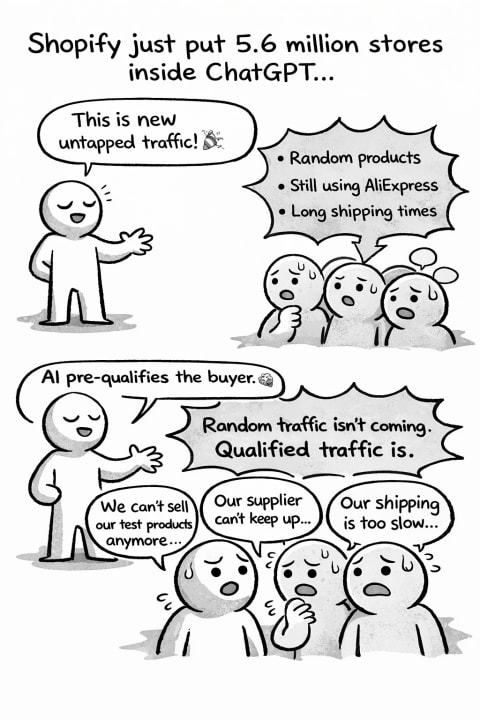
⚠️ 5.6 million stores just became “AI-native”
Shopify didn’t ask for permission.
They turned on Agentic Storefronts by default.
That means:
👉 Your store is already being surfaced inside AI
👉 Your products are already being recommended
👉 You are
On March 24, something quietly happened.
No announcement hype.
No “new feature” buzz.
But it may matter more than any ad strategy you’re running right now.
⚠️ 5.6 million stores just became “AI-native”
Shopify didn’t ask for permission.
They turned on Agentic Storefronts by default.
That means:
👉 Your store is already being surfaced inside AI
👉 Your products are already being recommended
👉 You are already competing there
Whether you prepared for it or not.
The shift most people are missing
This is not “another traffic channel”.
This is:
Discovery moving outside your store completely.
Before:
— Customer sees ad → clicks → lands on your product page
Now:
— Customer asks AI → AI chooses product → sends them to checkout
👉 Your product page is no longer the first impression
👉 Your data is
🧠 The uncomfortable truth
You are no longer competing as a store.
You are competing as:
— a data point
— inside a cluster
— inside a machine decision
Because Shopify Catalog:
— groups identical products
— compares sellers
— normalises listings
👉 Your product is not “yours” anymore
👉 It’s one option among many in an AI decision layer
🚨 Where dropshippers are actually exposed (this part is critical)
1) Inventory risk just went exponential
Before:
— Bad stock = a few angry customers
Now:
— AI recommends your product → thousands of people see it instantly
👉 If your supplier is slow or inaccurate:
— you can oversell at scale
— you can destroy your reviews overnight
One viral AI recommendation can break your entire backend.
2) Your “test products” are now liabilities
Most stores:
— dozens of random SKUs
— half-tested
— unclear positioning
AI doesn’t care.
It will surface them anyway.
👉 Meaning:
— your weakest products = highest risk exposure
— your catalog tail = your biggest vulnerability
3) You cannot hide from AI discovery
You can:
— disable checkout
— hide some products
But you cannot:
— fully opt out of being seen
👉 AI is now behaving like Google, not like a platform you can ignore
4) Bad data is worse than no data
AI reads:
— your title
— your description
— your structured data
Then decides:
— what your product is
— who it is for
— whether to recommend it
👉 If your listing is weak:
— AI will mis-sell your product
— conversions drop
— returns go up
🧠 The biggest insight (almost no one is talking about this)
AI traffic converts differently.
— AI traffic grew 7x
— AI orders grew 11x
👉 Orders grow faster than traffic
Why?
Because:
— AI pre-qualifies the buyer before they even click
Translation for dropshippers:
You don’t get:
— curiosity clicks
You get:
— expectation-driven buyers
Which means:
— your product must match expectation exactly
— your fulfillment must match promise exactly
⚠️ Where most dropshippers will fail
1) Still writing listings for humans
— short descriptions
— vague titles
— no structured data
👉 AI won’t understand your product properly
2) Treating this like “free traffic”
Yes, no 4% fee anymore.
But:
— competition exploded overnight
— 5.6 million stores entered instantly
👉 This is not early-stage arbitrage
👉 This is instant saturation
3) Ignoring fulfillment speed
AI buyers:
— convert faster
— expect faster delivery
If your model is:
— 10–15 day shipping from China
👉 You will get:
— worse reviews
— harsher expectations
— faster churn
4) Not controlling your catalog
Most dropshippers:
— upload everything
— test everything
Now:
— everything can be shown
👉 You need to curate what AI is allowed to see
🧩 What smart operators will do immediately
1) Clean your catalog
— remove weak SKUs
— hide unstable products
— focus on proven items
2) Rewrite titles for AI queries
Bad:
— “Blue Shirt XL”
Good:
— “Breathable cotton gym shirt for humid weather (men XL)”
👉 Think like a search query, not a product name
3) Fix descriptions
Your description should:
— explain use case
— handle objections
— define who it’s for
Because:
— AI uses it to sell for you
4) Tighten inventory buffers
Especially if:
— supplier latency is high
— stock updates are slow
👉 Inventory accuracy is now a growth lever, not ops detail
5) Align logistics with expectation
If AI drives:
— faster decision-making
You need:
— faster fulfillment
OR
— clearer delivery expectations
🔥 The real connection (this ties everything together)
Look at what’s happening at the same time:
— Amazon moving inventory upstream into China
— JD building global logistics infrastructure
— Shopify pushing AI-driven discovery
👉 These are not separate trends.
They are converging into one system:
— AI decides demand
— Logistics fulfills instantly
— Data determines who wins
Final thought
Dropshippers used to win by:
— finding products early
— running ads faster
Now?
You win by being the product AI chooses.
And AI doesn’t choose based on:
— hype
— luck
— “winning product” lists
It chooses based on:
— data clarity
— fulfillment reliability
— consistency
Most people will realise this too late.
The ones who move now will look “lucky” later.
Amazon didn’t just open a warehouse in Shenzhen.
They changed where the game is played.
What actually happened
On April 9, Amazon launched its first Global Warehousing & Distribution (GWD) centre in Shenzhen.
On the surface:
— Store inventory in China
— Ship to US when needed
But underneath:
They pulled fulfillment upstream into the factory layer itself.
This is not logistics.
This is control.
🧠 What Amazon is really doing
1)
Amazon didn’t just open a warehouse in Shenzhen.
They changed where the game is played.
What actually happened
On April 9, Amazon launched its first Global Warehousing & Distribution (GWD) centre in Shenzhen.
On the surface:
— Store inventory in China
— Ship to US when needed
But underneath:
They pulled fulfillment upstream into the factory layer itself.
This is not logistics.
This is control.
🧠 What Amazon is really doing
1) They are collapsing the entire supply chain into one system
Factory → warehouse → customs → freight → US fulfillment
All inside Amazon’s infrastructure.
👉 No more fragmented:
— supplier
— agent
— freight forwarder
— 3PL
It becomes one controlled pipeline.
2) They are killing the biggest inefficiency in ecommerce
Old model:
— Ship bulk to US
— Guess demand
— Tie up cash
— Overstock or stockout
New model:
— Hold bulk in China
— Replenish dynamically based on real sales
👉 Result:
— Up to 45% storage cost reduction
— Faster restocking
— Lower working capital pressure
3) They are copying what Temu / Shein already figured out
— Inventory stays closer to factories
— Demand signals control flow
— Speed comes from system design, not courier choice
Amazon is not innovating.
They are catching up.
4) They are preparing for global replication
This Shenzhen node is not the end.
It’s the prototype for:
— China → US
— China → EU
— China → Japan
👉 A global upstream inventory network.
⚠️ What dropshippers need to understand (this is the important part)
1) The old model is quietly dying
The classic play:
— Find product
— List on Shopify
— Ship from AliExpress
That model depends on:
— cheap parcels
— slow shipping tolerance
— low compliance
All 3 are breaking at the same time.
2) Logistics is becoming the moat
Look at what’s happening across the board:
— JD.com building EU warehouses + last mile
— Cainiao doubling warehouse productivity with robots
— Amazon moving upstream into China
👉 Everyone is investing in infrastructure, not products.
3) Speed is no longer about courier choice
Most dropshippers still think:
“Use faster shipping line = win”
Reality now:
— Speed = inventory positioning
— Speed = system integration
— Speed = data + replenishment
Not just YunExpress vs 4PX.
4) Compliance is becoming non-negotiable
At the same time:
— EU tightening product + tax rules
— US removing loopholes
— Platforms increasing liability
👉 Meaning:
— Random supplier = risk
— No documentation = risk
— No control = risk
5) Returns are being solved (this changes unit economics)
China just expanded nationwide customs return handling.
👉 Historically:
Returns = nightmare
Expensive / slow / messy
👉 Now:
Reverse logistics becoming smoother.
Enables real DTC models, not just “ship and forget”.
🧠 The deeper shift (most people miss this)
This is not about Amazon.
This is about where value is moving in the stack.
Old value:
— product sourcing
— price arbitrage
New value:
— supply chain design
— inventory flow control
— compliance + infrastructure
🚨 What dropshippers should be cautious about
1) Depending fully on AliExpress-style fulfillment
You are:
— slow
— exposed to policy changes
— replaceable
2) Ignoring inventory strategy
If you don’t control:
— stock levels
— replenishment timing
You will lose to people who do.
3) Treating logistics as a backend problem
It is no longer backend.
It is your core competitive advantage.
4) Not preparing for policy changes
— De minimis changes
— EU fees
— platform liability
These are not “news”.
They are margin killers.
🧩 What smart operators will start doing now
— Move toward private agents / direct factory sourcing
— Test inventory staging in China (not just direct ship)
— Add light overseas stocking for winners
— Build repeatable supply chains, not one-off products
— Think in systems, not products
Final thought
Amazon didn’t build a warehouse.
They made a statement:
"The future of ecommerce is not who finds the product.
It’s who controls the flow of goods."
Most dropshippers are still playing the old game.
The platform players already moved on.

If you are still trying to find a "hidden" winning product...
You are already late.
After going through multiple datasets, transcripts, and real stores doing $100K to $300K a month, one thing becomes incredibly clear:
👉 The product is no longer the edge.
The real edge is:
— how fast you spot it
— how fast you launch it
— how aggressively you push it
WHAT ACTUALLY CHANGED IN 2026
Most people are still playing
If you are still trying to find a "hidden" winning product...
You are already late.
After going through multiple datasets, transcripts, and real stores doing $100K to $300K a month, one thing becomes incredibly clear:
👉 The product is no longer the edge.
The real edge is:
— how fast you spot it
— how fast you launch it
— how aggressively you push it
WHAT ACTUALLY CHANGED IN 2026
Most people are still playing this outdated game:
Find a unique product → run ads → hope it works.
But the operators doing real numbers are running something very different. They operate:
👉 A 30-day ecosystem.
Organic → Paid → Search → Geo-expansion → Bundling → Repeat.
This is what actually drives consistent 6-figure months now. Here are the 20 rules the top 1% are using to scale.
PHASE 1: THE ORGANIC PIPELINE (ATTENTION OVER UTILITY)
- "Stupid" products outperform "useful" ones
They are random, weird, and unnecessary.
Why? Because they do one thing extremely well...
👉 They stop the scroll.
- The real KPI is NOT conversion
Would a stranger say "what the hell is that?" in 2 seconds?
If yes → it has distribution potential.
If no → it dies quietly.
- High virality beats high conversion
Product A → 5% conversion, 1M views
Product B → 1% conversion, 50M views
👉 Distribution beats efficiency.
- Organic is now a volume game
Most people post 2 videos and conclude "the product doesn't work."
PHASE 2: AD ARBITRAGE (WHERE THE MONEY IS MADE)
- Meta educates. Google converts.
👉 If you are not running Google Search ads, you are letting competitors pay for your customers.
- High-ticket works better on search
On Google, $100 to $400 products convert easily.
TikTok is for entertainment. Google is for buying.
- The biggest silent killer is turning off ads too early
But some ads start the buyer journey, while others close it.
👉 Turn off the wrong top-of-funnel ad, and your entire funnel weakens.
- "Saturated" is completely misunderstood
It means the product is proven to convert.
The real question is: are you advertising where everyone is, or where they are not?
- Geo-arbitrage is still a massive cheat code
Translate the winning creatives.
Launch it in the EU or Australia.
👉 The exact same product becomes a brand new winner.
PHASE 3: STORE ENGINEERING
- Your product page does more work than your ads
Most stores use a basic template and copied descriptions.
👉 Same product, drastically different conversion rate.
- Pricing is pure psychology
How? Branding, perceived value, and interest-free payment plans.
👉 You are selling perception, not cost.
- Bundling is no longer optional
Most dropshippers sell 1 unit.
👉 Selling single units is exactly why scaling fails.
- If customers can guess your cost, you lose
The worst products look obviously cheap.
👉 Perceived cost puts a hard cap on your pricing.
- Fake authority kills conversions
PHASE 4: OPERATIONS (WHERE WINNERS DIE)
- Supply chain kills more stores than bad ads
But slow shipping and poor quality lead to refunds, chargebacks, and gateway shutdowns.
👉 Operations dictate your longevity.
- Margin is your survival oxygen
- Speed is the ultimate moat
The winner is who launches first, who tests fastest, and who iterates the quickest.
- Competitor tracking is mandatory
👉 Operating without this data is just guessing.
- Most winners are not "new" products
👉 A new angle always beats a new product.
- The biggest paradigm shift
CLOSING
You don't just "find" winning products anymore.
You enter existing demand...
👉 and out-execute everyone already there.

You just don’t realize you’re competing with it yet.
Take a look at their recent numbers:
Record Revenue: ¥21.4B (+26%)
Q4 Growth: +32.7%
Global Footprint: 8,000+ stores
Forecast: High-teens growth guided for next year
This is not just a "retail brand." It is a supply chain and product engine.
Here is what Miniso is actually doing that most dropshippers are entirely missing.
What Miniso is Doing Right
1. Speed is the
You just don’t realize you’re competing with it yet.
Take a look at their recent numbers:
Record Revenue: ¥21.4B (+26%)
Q4 Growth: +32.7%
Global Footprint: 8,000+ stores
Forecast: High-teens growth guided for next year
This is not just a "retail brand." It is a supply chain and product engine.
Here is what Miniso is actually doing that most dropshippers are entirely missing.
What Miniso is Doing Right
1. Speed is the Real Moat
Miniso launches 80 to 100 new SKUs every single week, moving from concept to shelf in just 4 to 8 weeks. This is significantly faster than the average dropshipper’s testing cycle. By the time you find one "winner," they have already tested 300.
2. They Manufacture Demand
With over 1,500 suppliers, an in-house design team, and AI-driven social trend scraping, Miniso does not react to trends. They create the supply before you even see the demand.
3. IP is Margin Control, Not Just Branding
Over 25–35% of their sales come from Intellectual Property (IP) products. This matters because it utilizes the same factory cost but commands a higher selling price and drives stronger repeat purchases. This is how you turn a commodity into margin.
4. Distribution is the Hidden Advantage
Miniso has collapsed logistics and retail into one seamless system through ship-from-store, buy-online-pickup-in-store (BOPIS), and shared inventory. The result is faster delivery, lower cost per order, and a better customer experience. Whether you realize it or not, this is the baseline your customers are starting to compare you against.
5. They Optimize for the Repeat, Not the First Sale
Their model thrives on continuous newness. Constant new SKUs, IP-driven collections, and an engaging store experience actively pull people back. Repeat purchases are engineered, not hoped for.
What This Means For Dropshippers
Most people in the community think the main problem right now is, "Ads are getting expensive." That is not the real problem. The real shift is this: Your supply chain is slower than your competition.
The New Reality:
If your product takes 2–3 weeks to ship, if your supplier only reacts after orders come in, and if your SKU has zero differentiation—you are competing purely on traffic arbitrage.
That layer of the game is getting compressed every single year.
Miniso’s net margin recently compressed to ~10.8%, even at their massive scale. If the best operators in the world are fighting margin pressure, and your only edge is slightly better ads or slightly cheaper sourcing, you will lose over time.
The Practical Shift: What Actually Works Now
To survive and scale, you need to adapt your operations immediately.
1. Shorten Your Supply Loop
Stop relying on the pure "order → supplier → ship" model. Move toward holding light inventory on your top SKUs, setting up faster replenishment cycles, and working closely with your dropshipping agents to compress fulfillment times and streamline your high-volume communications.
2. Build Product Control
You don't need a massive, full-scale brand on day one, but you must break 1:1 comparability. Introduce slight product modifications, create custom bundled offers, or utilize basic private labeling.
3. Engineer Repeat Purchases
Miniso doesn't rely on one winning SKU; they rely on seasonal drops and collections. Build your version of this using consumables, logical product bundles, aggressive follow-up offers, and backend email/SMS flows.
4. Think in Systems, Not Products
Miniso isn’t asking, "What’s the next winner?" They are asking, "How do we launch 100 products a week consistently?" That is the operational level most dropshippers haven’t even begun to reach.
The Bottom Line
You have two paths from here:
Path 1 (The Common Route): Keep chasing short-lifecycle winners (2–6 months) and constantly resetting your business from zero.
Path 2 (The Emerging Route): Control your supply, build small differentiation, stack repeat purchases, and compound your growth over time.
The game is no longer about who finds the product first. The game is about who controls speed, supply, and repeat purchases. Miniso isn’t your direct competitor in the obvious way. They are your directional warning.


However, I’m stuck on one issue: one of my products keeps getting flagged for Etsy’s creativity standards violation and I can’t figure out how to resolve it.
If anyone has dealt with this before and knows how to fix it, I’d really appreciate the help — it would make a big difference.
If I were to hazard a guess, that "creativity standards" flag usually has nothing to do with your actual product. it’s just an automated reverse-image search. If your main photo is the exact same one the factory uses on aliexpress or 1688, the bot catches it immediately.
Potentially this can work:
Ditch the factory photos. ask your china agent to snap a quick raw photo on their office desk before shipping,
If I were to hazard a guess, that "creativity standards" flag usually has nothing to do with your actual product. it’s just an automated reverse-image search. If your main photo is the exact same one the factory uses on aliexpress or 1688, the bot catches it immediately.
Potentially this can work:
Ditch the factory photos. ask your china agent to snap a quick raw photo on their office desk before shipping, or use photoroom to completely swap the background. you just need to break the original image hash so the bot can't read it.
Or add a tiny custom touch. ask your agent to throw in a cheap personalized element—like a custom thank-you card or a laser-engraved tag. it costs us like 5 cents to do this in Guangzhou, but to Etsy, it shifts your item from "generic dropship" to "customized product."

happy to be here 👋
I’m from Germany and currently running multiple online stores in the dropshipping space, as well as building a fashion brand. Really excited to connect with like-minded people, exchange ideas, and see how others approach their processes.
Always open to learning, improving, and meeting other hustlers in the space 🤝
Looking forward to connecting with you all!
Running multiple dropship stores out of Germany while spinning up a fashion brand is a heavy operational load. Usually, the jump from dropship cashflow to holding apparel inventory is what breaks people.
Curious about how you're structuring the transition. Are you funding the fashion brand's upfront MOQs directly from the dropship store profits, or running a pre-order model to validate the custom cuts first?

Your 8% CTR and $0.16 CPC show the emotional hook is landing. Top of funnel is validated.
The unit economics are where this gets hard. You are carving out 20% of net profit on top of custom printing COGS. Charity angles always drive cheap clicks, but the conversion rate often tanks when people realize it's a $50
Your 8% CTR and $0.16 CPC show the emotional hook is landing. Top of funnel is validated.
The unit economics are where this gets hard. You are carving out 20% of net profit on top of custom printing COGS. Charity angles always drive cheap clicks, but the conversion rate often tanks when people realize it's a $50 apparel checkout, not a GoFundMe. Your allowable CAC is going to be razor-thin.
Run the launch. Let the pixel season. Next week, skip the click data and drop the hard numbers for the group: site conversion rate, blended CAC, and true net margin per order.
Curious about the actual fulfillment side—what app or logistics stack are you using to route custom Bali drawings into a POD pipeline without blowing up your delivery SLAs?
The real damage to dropship margins isn't coming from higher shipping costs.
It's coming from something most sellers don't even track.
Why most stores lose margin before they notice
Every dropship SKU has a hidden contract with its freight quote.
The quote gives you a landed cost.
You price the product.
You run ads.
The whole P&L depends on that one number
The real damage to dropship margins isn't coming from higher shipping costs.
It's coming from something most sellers don't even track.
Why most stores lose margin before they notice
Every dropship SKU has a hidden contract with its freight quote.
The quote gives you a landed cost.
You price the product.
You run ads.
The whole P&L depends on that one number holding still long enough for your pricing to stay profitable.
Most operators think shipping cost risk shows up when the carrier sends a new rate card.
By then, you've already shipped 45 days of orders at stale economics.
The risk actually shows up much earlier, through a coordinated move across three timeframes:
the energy and refinery signals (your 45-day lead time)
the airline and ocean signals (your 30-day lead time)
the forwarder and final-mile signals (your 7-day lead time)
Winning operators read all three. Most dropshippers only watch the last one, and only when the invoice arrives.
Margin compression doesn't begin when costs rise. It begins when volatility moves faster than your store can reprice.
The Four Mechanisms the Market Just Revealed
After reading the latest earnings prints across the entire freight chain, the same four mechanisms appear in all of them. Not as headlines. As psychological and operational architecture working against asset-light sellers.
1. The Decoupling Signal
BP's Q1 refining indicator margin came in at $16.9/bbl, up from $15.2/bbl.
Most ecom operators scroll past numbers like this.
They shouldn't.
Refining margin is the profit a refiner makes turning crude into diesel, jet fuel, and gasoline.
When that margin expands, wholesale fuel is decoupling from crude. Your freight costs spike even if the headlines say oil is flat.
Three reinforcing signals sit underneath this:
refinery utilization is dropping due to delayed maintenance cycles. tight jet fuel supply is structural for the next two quarters, not a blip.
brent crude is in backwardation — spot market fuel is wildly more expensive than futures. dropshippers buy logistics on the spot market. you pay the maximum premium.
oil majors are prioritizing buybacks over capex. no new refining capacity is coming online to save your margins.
So instead of reading BP's print as:
"oil news, not relevant"
Read it as:
"my per-parcel shipping cost is being set right now, at a desk I've never seen, based on numbers I could have tracked."
The first read keeps you reactive. The second one gets you 45 days ahead of the invoice.
2. The Lease Reset
Shell guided Q1 refining margin to $17/bbl, up from $14/bbl.
Two supermajors moving in the same direction is a confirmation signal.
What makes Shell's print worse for dropshippers is a separate line in the same release:
"variable components of long-term shipping leases expected to increase by $3–4 billion in the current macro environment."
Translation: ocean and air freight contract rates are resetting higher across the entire logistics chain. Carriers are locking in higher base rates. Your agent's volume discount is getting wiped out at the corporate level, upstream of your negotiation.
The ocean side is worse than the headline suggests:
Maersk and Hapag-Lloyd are executing blank sailings, artificially constraining capacity to keep rates high and forcing desperate sellers onto expensive air freight.
Panama and Suez diversions are now priced into baseline models. 14 days of extra transit is the new normal. Sea-to-air conversion costs 4x more per kg.
air cargo yields from Asia to the US remain elevated despite being off-peak, because Temu and Shein are buying up baseline cargo capacity. You're bidding against multi-billion dollar freight budgets.
Big retailers hedge this exposure. They lock freight contracts 6-12 months forward. They negotiate volume discounts. They absorb volatility for quarters.
Most dropshippers don't have that leverage.
Once the concept is named — "your freight quote is decaying in real time" — every stale quote in your spreadsheet becomes an active margin leak.
The work is finding which SKUs are leaking, and how fast.
3. The Asset Asymmetry
Delta guided Q2 fuel at roughly $4.30/gallon. Nearly double year-over-year.
When the fuel number doubles and airlines still guide to profit, the viewer — or in this case, the operator — has their first objection resolved before they could fully form it.
The objection being: "maybe this is just a blip."
The key word is before.
Delta preemptively told the market that fuel at this level is the new baseline for at least one quarter.
Airlines that own refineries (Delta's Trainer refinery offsets $300M of their Q1 fuel cost) can absorb this. Asset-light dropshippers absorb the entire tax.
Same pattern shows up one layer down:
UPS and FedEx domestic volumes are down, but revenue per piece is up. They're ruthlessly squeezing margins out of lightweight ecommerce parcels.
DHL Express is prioritizing B2B volume over B2C cross-border. Your packages will get hit with peak surcharges earlier in the season.
CH Robinson's net revenue margins are shrinking. Freight forwarders are passing costs directly down to tier-3 clients. Dropshippers are tier-3 clients.
Instead of going from:
assume shipping cost is stable → run ads → notice margin gap late
Operators who survive this quarter go:
assume shipping cost is volatile → reprice weekly → catch the gap before it compounds
4. The Repricing Tax
DHL has moved to weekly fuel surcharge updates.
This is the most directly operational signal of all, and the most consistently underused.
A freight quote secured on the first of the month is mathematically obsolete by the fifteenth.
Regional final-mile carriers are adopting dynamic fuel pricing too. Your domestic 3PL cost will fluctuate weekly alongside your cross-border freight.
Kahneman's loss aversion research applies here: the pain of a margin loss you didn't see coming is roughly twice as sharp as the gain from a margin win you planned for.
Operators who've actually survived a shipping volatility cycle use this consistently.
The weekly quote stops being a nice-to-have.
Not updating it is making your P&L actively worse right now.
"A week ago this SKU made $7 per order. Today it makes $4. Nothing changed except the fuel surcharge on air freight, and I haven't seen the invoice yet."
Loss aversion and contribution margin drift are the most dangerous combination in dropshipping.
The Operator Architecture
Building a pricing process that responds to all four mechanisms is hard.
Here's when to use each one:
The upstream signals (BP, Shell, refinery utilization, backwardation) tell you the direction. That's your 45-day lead time.
The middle signals (Delta, ocean capacity, Temu/Shein cargo buying, forwarder margin compression) tell you the magnitude. That's when you model new landed costs for your top 20 SKUs.
The downstream signals (DHL weekly surcharge, dynamic final-mile pricing, volumetric weight algorithms getting stricter) tell you the timing. That's when you actually reprice.
Then the discipline:
kill the 30-day freight quote. Force your agent to quote on a 7-day validity cycle.
rank every SKU by contribution margin after shipping, not gross margin. Some "winners" are already underwater.
audit custom packaging. A 2-inch dimension change on a kitchen gadget now destroys net profit under stricter volumetric weight rules.
connect a weekly repricing script in Shopify to your agent's live freight sheet. Static pricing models fail in this environment.
recalculate the SKU viability threshold. Combined landed cost volatility and Meta CPM inflation ($8.77 avg) means sub-$40 AOV SKUs are mathematically unviable without a 40%+ repeat purchase rate.
If a $1-2 change in shipping can wreck your contribution margin, the SKU wasn't robust enough to begin with.
The market just told you which way freight is moving, from four different points in the chain. The operators who hear the signal reprice before the invoice arrives. The ones who don't find out 45 days late, in the P&L.

It is not a demand problem.
It is a customer selection problem.
And most stores are selling to the wrong one.
Delta Q1 quietly showed something very few people are saying clearly:
Premium demand → unchanged
Corporate → accelerating
Amex spend → +12%
Economy → only just stabilising after 5 quarters
This is not recovery.
This is a permanent split.
THERE ARE NOW THREE DIFFERENT CUSTOMERS.
And they behave like
It is not a demand problem.
It is a customer selection problem.
And most stores are selling to the wrong one.
Delta Q1 quietly showed something very few people are saying clearly:
Premium demand → unchanged
Corporate → accelerating
Amex spend → +12%
Economy → only just stabilising after 5 quarters
This is not recovery.
This is a permanent split.
THERE ARE NOW THREE DIFFERENT CUSTOMERS.
And they behave like completely different markets.
High-end → does not react to price
Mid-tier → spends again, but expects justification
Low-end → still constrained, still price-sensitive, still unstable
Most stores are trying to sell to all three.
That is the mistake.
THE REAL SHIFT (THIS IS WHAT PEOPLE MISS):
This is not about “premium vs cheap”.
This is about who absorbs friction.
High-end absorbs price
Mid-tier absorbs story + perceived value
Low-end absorbs nothing
If your product needs:
explanation
trust
emotional buy-in
…it cannot survive in the low-end segment anymore.
THIS IS WHY CONVERSION FEELS “RANDOM” RIGHT NOW
Same product.
Same ad.
Same landing page.
Some days it prints.
Some days it dies.
It is not the algorithm.
You are rotating between customer tiers without realising it.
WHAT IS ACTUALLY WORKING (ACROSS STORES RIGHT NOW):
Not “cheap products”.
Not even “winning products”.
But a very specific zone:
$40–80 price point
Clear perceived upgrade vs commodity
Emotionally justifiable (gift / comfort / identity)
Not purely functional
This is where:
👉 hesitation is low
👉 competition is weaker
👉 margins still exist
WHY MOST STORES GET SQUEEZED
Because they sit in the worst possible position:
Too expensive for low-end
Too generic for mid-tier
Too cheap-looking for high-end
That middle zone used to work.
Now it gets attacked from both sides:
Amazon dominates price + logistics
Premium brands dominate perception
You sit in between → you lose both battles.
THE TWO REAL PLAYS NOW
Not 10 strategies. Just 2.
1. TRADE UP
Remove lowest SKU
Bundle aggressively
Push AOV > $60
Accept lower volume
You are choosing margin over traffic.
2. REFRAME THE SAME PRODUCT
Same cost.
Different positioning.
“Cheap gadget” → dies
“Everyday upgrade” → converts
You are not changing the product.
You are changing who it is for.
WHAT TO WATCH (THIS IS WHERE SIGNAL IS):
AOV trend (weekly, not monthly)
Bundle attach rate
CVR split by price tier
Repeat purchase behaviour (mid-tier returning = very bullish)
Tools like Shopify + Klaviyo are not “nice to have” anymore.
They are how you separate customers by tier.
THE HARDEST TRUTH
Low-end demand did not disappear.
It became unreliable.
You can still make money there.
But you cannot build a stable store on it anymore.
BOTTOM LINE
Two customers are spending.
One is not.
Most stores are still chasing the one that isn’t.
That is why results feel harder than they should.

Dropshipping Didn’t Get Harder.
It Got More Honest.
Most dropshippers won’t fail because of tariffs.
They won’t fail because of competition.
They won’t fail because “dropshipping is dead.”
They will fail because the model they are running no longer works.
The market didn’t change overnight.
But the standard did.
But Opportunity Is Expanding.
This is where most people get it wrong.
They see pressure —
and assume decline.
Signal
Costs rising, but demand remains strong.
Data
Shopify, Amazon, eBay, and Etsy all continue to report GMV growth despite macro pressure.
Implication
This is not a shrinking market.
This is a filtering phase.
Weak operators exit.
Structured operators absorb.
Action
Focus on:
• Fewer, stronger SKUs
• Better pricing control
•
But Opportunity Is Expanding.
This is where most people get it wrong.
They see pressure —
and assume decline.
Signal
Costs rising, but demand remains strong.
Data
Shopify, Amazon, eBay, and Etsy all continue to report GMV growth despite macro pressure.
Implication
This is not a shrinking market.
This is a filtering phase.
Weak operators exit.
Structured operators absorb.
Action
Focus on:
• Fewer, stronger SKUs
• Better pricing control
• Higher-ticket products
Because margin is now designed — not assumed.
Dropshipping Didn’t Get Harder.
It Got More Honest.
Most dropshippers won’t fail because of tariffs.
They won’t fail because of competition.
They won’t fail because “dropshipping is dead.”
They will fail because the model they are running no longer works.
The market didn’t change overnight.
But the standard did.
It Is a Conversion Killer.
There was a time when 2–3 weeks was acceptable.
That time is over.
Signal
Delivery expectations continue to accelerate.
Data
Amazon continues to expand same-day and faster delivery,
resetting expectations across e-commerce.
Implication
Speed is no longer a differentiator.
It is the baseline.
You don’t need to beat Amazon.
But you cannot be far from it.
Action
Aim for:
• 2–5 day delivery (local fulfillment)
• Clear
It Is a Conversion Killer.
There was a time when 2–3 weeks was acceptable.
That time is over.
Signal
Delivery expectations continue to accelerate.
Data
Amazon continues to expand same-day and faster delivery,
resetting expectations across e-commerce.
Implication
Speed is no longer a differentiator.
It is the baseline.
You don’t need to beat Amazon.
But you cannot be far from it.
Action
Aim for:
• 2–5 day delivery (local fulfillment)
• Clear shipping communication
• Reliable tracking
Because uncertainty kills conversions.
Dropshipping Didn’t Get Harder.
It Got More Honest.
Most dropshippers won’t fail because of tariffs.
They won’t fail because of competition.
They won’t fail because “dropshipping is dead.”
They will fail because the model they are running no longer works.
The market didn’t change overnight.
But the standard did.
They Are Being Replaced.
This is subtle — but important.
Signal
Secondhand and recommerce are growing.
Data
eBay reports a significant portion of GMV from secondhand,
with younger consumers increasingly shifting toward recommerce platforms.
Implication
Consumers are choosing:
• cheaper (secondhand)
or
• better (higher-quality new)
Not generic cheap.
The middle is disappearing.
Action
Choose your side:
• Higher quality
• Strong positioning
•
They Are Being Replaced.
This is subtle — but important.
Signal
Secondhand and recommerce are growing.
Data
eBay reports a significant portion of GMV from secondhand,
with younger consumers increasingly shifting toward recommerce platforms.
Implication
Consumers are choosing:
• cheaper (secondhand)
or
• better (higher-quality new)
Not generic cheap.
The middle is disappearing.
Action
Choose your side:
• Higher quality
• Strong positioning
• Clear differentiation
Because “average” is no longer viable.
Dropshipping Didn’t Get Harder.
It Got More Honest.
Most dropshippers won’t fail because of tariffs.
They won’t fail because of competition.
They won’t fail because “dropshipping is dead.”
They will fail because the model they are running no longer works.
The market didn’t change overnight.
But the standard did.
It Is Becoming a Gatekeeper.
This is where most people are not paying attention.
Signal
Amazon’s AI (Rufus) is expanding beyond its own platform.
Data
Amazon reported hundreds of millions of users engaging with AI shopping tools,
with higher conversion rates among those users.
Implication
Amazon is positioning itself between:
• the customer
• and every store
Including yours.
Traffic is no longer owned.
It is routed.
Action
Build independence:
•
It Is Becoming a Gatekeeper.
This is where most people are not paying attention.
Signal
Amazon’s AI (Rufus) is expanding beyond its own platform.
Data
Amazon reported hundreds of millions of users engaging with AI shopping tools,
with higher conversion rates among those users.
Implication
Amazon is positioning itself between:
• the customer
• and every store
Including yours.
Traffic is no longer owned.
It is routed.
Action
Build independence:
• Multi-channel traffic
• Strong store conversion
• Brand-level trust
Because platforms will optimize for themselves — not you.
Dropshipping Didn’t Get Harder.
It Got More Honest.
Most dropshippers won’t fail because of tariffs.
They won’t fail because of competition.
They won’t fail because “dropshipping is dead.”
They will fail because the model they are running no longer works.
The market didn’t change overnight.
But the standard did.
It Is the System.
Many still use Shopify like it’s 2018.
Basic store.
Basic checkout.
Basic setup.
That’s not how the platform works anymore.
Signal
Shopify ecosystem is scaling rapidly.
Data
Shopify reported ~$124B GMV in Q4,
with Shop Pay accounting for over half of US transactions.
Implication
Conversion is no longer just design.
It is infrastructure:
• Payments
• Trust layers
• Data
Stores not using these are not “slightly worse.”
They are
It Is the System.
Many still use Shopify like it’s 2018.
Basic store.
Basic checkout.
Basic setup.
That’s not how the platform works anymore.
Signal
Shopify ecosystem is scaling rapidly.
Data
Shopify reported ~$124B GMV in Q4,
with Shop Pay accounting for over half of US transactions.
Implication
Conversion is no longer just design.
It is infrastructure:
• Payments
• Trust layers
• Data
Stores not using these are not “slightly worse.”
They are structurally behind.
Action
Enable:
• Shop Pay
• Shopify Payments
• Full product data
Because the system rewards those who use it fully.
Dropshipping Didn’t Get Harder.
It Got More Honest.
Most dropshippers won’t fail because of tariffs.
They won’t fail because of competition.
They won’t fail because “dropshipping is dead.”
They will fail because the model they are running no longer works.
The market didn’t change overnight.
But the standard did.
It Got Removed.
Everyone is watching Temu.
Everyone is watching Shein.
Few understand what just happened.
Signal
The direct-from-China cheap model is under pressure.
Data
As highlighted in Amazon marketplace data and cross-border trade changes,
low-cost, direct-to-consumer shipments are the most exposed to new cost structures.
Implication
Cheap direct shipping lost its edge.
But structured sourcing did not.
The operators who:
• source properly
•
It Got Removed.
Everyone is watching Temu.
Everyone is watching Shein.
Few understand what just happened.
Signal
The direct-from-China cheap model is under pressure.
Data
As highlighted in Amazon marketplace data and cross-border trade changes,
low-cost, direct-to-consumer shipments are the most exposed to new cost structures.
Implication
Cheap direct shipping lost its edge.
But structured sourcing did not.
The operators who:
• source properly
• ship in bulk
• fulfill locally
are now in a stronger position than before.
The floor moved up.
Most people are still standing on the old one.
Action
Reposition:
• Not cheapest
• But faster, more reliable, better structured
That is where the gap is now.
Dropship Community
Global Community for Dropshippers and Sellers
Dropship Community is a global community for real dropshippers and e-commerce entrepreneurs.
Discover winning products before they saturate, get honest feedback from experienced sellers, and learn what's actually working right now.
No fluff. No gurus. Just actionable strategies and practical conversations that move your business forward.





…join many more real dropshippers and store owners already inside
What makes Dropship Community different
"Now I don't have to go to Reddit and ask for feedback on 10 different Facebook groups for my store. The community here just gets it."
"Love browsing the product finds here. Sellers are sharing genuinely profitable products before they blow up on TikTok."
"Real dropshippers actually helping each other with no spam from course sellers and fake gurus. The signal-to-noise ratio here is incredible."
"Running a dropshipping store doesn't feel lonely here. Everyone understands the challenges on this journey."