←
Post

Discussion
Most Sellers Watch the Missiles.
Smart Operators Watch Their Margins.
The Iran war is not mainly about bombs. It's about a chain reaction that hits your P&L before you see it coming. Oil, shipping insurance, air cargo, delivery times, inflation, consumer demand — that's where your margins get killed first.
Signal 01
The Strait of Hormuz Is Still the Story
Ship transits through Hormuz dropped from roughly 130 per day in February to 6 in March. The IEA called
Smart Operators Watch Their Margins.
The Iran war is not mainly about bombs. It's about a chain reaction that hits your P&L before you see it coming. Oil, shipping insurance, air cargo, delivery times, inflation, consumer demand — that's where your margins get killed first.
Signal 01
The Strait of Hormuz Is Still the Story
Ship transits through Hormuz dropped from roughly 130 per day in February to 6 in March. The IEA called
Most Sellers Watch the Missiles.
Smart Operators Watch Their Margins.
The Iran war is not mainly about bombs. It's about a chain reaction that hits your P&L before you see it coming. Oil, shipping insurance, air cargo, delivery times, inflation, consumer demand — that's where your margins get killed first.
Signal 01
The Strait of Hormuz Is Still the Story
Ship transits through Hormuz dropped from roughly 130 per day in February to 6 in March. The IEA called this the largest supply disruption in the history of the global oil market — worse than the 1970s oil crises combined. Brent crude surged over 60% in March alone, the biggest monthly gain since records began.
Trump's 8 p.m. ET Tuesday deadline for Iran to reopen the strait is hours away. Iran rejected the latest ceasefire proposal and is demanding a permanent end to the war. Even Eurasia Group warns that the oil supply situation will double in severity by mid-April as strategic reserves run dry.
Signal
Energy costs are not just elevated — they are structurally disrupted with no clear timeline for normalization.
Why It Matters
Your shipping, supplier, packaging, and ad costs don't need to rise all at once to hurt you. Fuel alone starts the chain. Jet fuel has more than doubled. Diesel and bunker fuel are at record highs. Every link in your supply chain runs on energy.
⚡ Action
Recheck margins on every low-ticket product today. Especially bulky, fragile, low-AOV, or free-shipping offers. If your margin was 15% before and fuel adds 5-8% to fulfillment, you're underwater.
Don't price your business as if this is temporary. Even if a ceasefire happens tomorrow, Eurasia Group says it would take several months to repair damaged energy infrastructure and at least 2 months for tankers to resume — meaning 70+ empty oil tankers sitting off Singapore right now won't deliver barrels to Asia for 8+ weeks.
Smart Operators Watch Their Margins.
The Iran war is not mainly about bombs. It's about a chain reaction that hits your P&L before you see it coming. Oil, shipping insurance, air cargo, delivery times, inflation, consumer demand — that's where your margins get killed first.
Signal 01
The Strait of Hormuz Is Still the Story
Ship transits through Hormuz dropped from roughly 130 per day in February to 6 in March. The IEA called this the largest supply disruption in the history of the global oil market — worse than the 1970s oil crises combined. Brent crude surged over 60% in March alone, the biggest monthly gain since records began.
Trump's 8 p.m. ET Tuesday deadline for Iran to reopen the strait is hours away. Iran rejected the latest ceasefire proposal and is demanding a permanent end to the war. Even Eurasia Group warns that the oil supply situation will double in severity by mid-April as strategic reserves run dry.
Signal
Energy costs are not just elevated — they are structurally disrupted with no clear timeline for normalization.
Why It Matters
Your shipping, supplier, packaging, and ad costs don't need to rise all at once to hurt you. Fuel alone starts the chain. Jet fuel has more than doubled. Diesel and bunker fuel are at record highs. Every link in your supply chain runs on energy.
⚡ Action
Recheck margins on every low-ticket product today. Especially bulky, fragile, low-AOV, or free-shipping offers. If your margin was 15% before and fuel adds 5-8% to fulfillment, you're underwater.
Don't price your business as if this is temporary. Even if a ceasefire happens tomorrow, Eurasia Group says it would take several months to repair damaged energy infrastructure and at least 2 months for tankers to resume — meaning 70+ empty oil tankers sitting off Singapore right now won't deliver barrels to Asia for 8+ weeks.
9
1
Signal 05
Energy Infrastructure Attacks Are Expanding the Risk Map
This is no longer just about one chokepoint. Iran struck Saudi Arabia's Jubail petrochemical complex. Kuwait's oil facilities were hit by Iranian drones with "significant damage." Israel struck Iran's South Pars gas field. Qatar's Ras Laffan LNG complex — heavily damaged — will suppress global helium and gas supplies for up to 5 years.
Aluminum prices jumped 8% in March after Iran hit Emirates Global Aluminium. Tungsten has more than tripled since December. Urea fertilizer is up ~50%.
Signal
The war's economic impact is spreading well beyond the maritime bottleneck — into raw materials, petrochemicals, and industrial inputs.
Why It Matters
Even if Hormuz partially reopens, the broader industrial supply chain stays stressed. Products tied to petrochemical inputs can get squeezed indirectly:
plastics
packaging
adhesives
synthetic textiles
beauty containers
household goods
aluminum products
⚡ Action
Audit your product catalog for petrochemical exposure. Anything plastic-heavy, foam-based, or synthetically packaged is at risk of quiet cost creep.
Ask your supplier if they've received raw material price increases in the last 30 days. If they haven't passed them through yet, they will.
Energy Infrastructure Attacks Are Expanding the Risk Map
This is no longer just about one chokepoint. Iran struck Saudi Arabia's Jubail petrochemical complex. Kuwait's oil facilities were hit by Iranian drones with "significant damage." Israel struck Iran's South Pars gas field. Qatar's Ras Laffan LNG complex — heavily damaged — will suppress global helium and gas supplies for up to 5 years.
Aluminum prices jumped 8% in March after Iran hit Emirates Global Aluminium. Tungsten has more than tripled since December. Urea fertilizer is up ~50%.
Signal
The war's economic impact is spreading well beyond the maritime bottleneck — into raw materials, petrochemicals, and industrial inputs.
Why It Matters
Even if Hormuz partially reopens, the broader industrial supply chain stays stressed. Products tied to petrochemical inputs can get squeezed indirectly:
plastics
packaging
adhesives
synthetic textiles
beauty containers
household goods
aluminum products
⚡ Action
Audit your product catalog for petrochemical exposure. Anything plastic-heavy, foam-based, or synthetically packaged is at risk of quiet cost creep.
Ask your supplier if they've received raw material price increases in the last 30 days. If they haven't passed them through yet, they will.
2:47 PM · Apr 7, 2026
0
0
In review
Want to join the conversation? Sign in to reply.
Discover Posts
Discussion
🧠 Shopify just flipped a switch… and most dropshippers didn’t notice
On March 24, something quietly happened.
No announcement hype.
No “new feature” buzz.
But it may matter more than any ad strategy you’re running right now.
⚠️ 5.6 million stores just became “AI-native”
Shopify didn’t ask for permission.
They turned on Agentic Storefronts by default.
That means:
👉 Your store is already being surfaced inside AI
👉 Your products are already being recommended
👉 You are
On March 24, something quietly happened.
No announcement hype.
No “new feature” buzz.
But it may matter more than any ad strategy you’re running right now.
⚠️ 5.6 million stores just became “AI-native”
Shopify didn’t ask for permission.
They turned on Agentic Storefronts by default.
That means:
👉 Your store is already being surfaced inside AI
👉 Your products are already being recommended
👉 You are
🧠 Shopify just flipped a switch… and most dropshippers didn’t notice
On March 24, something quietly happened.
No announcement hype.
No “new feature” buzz.
But it may matter more than any ad strategy you’re running right now.
⚠️ 5.6 million stores just became “AI-native”
Shopify didn’t ask for permission.
They turned on Agentic Storefronts by default.
That means:
👉 Your store is already being surfaced inside AI
👉 Your products are already being recommended
👉 You are already competing there
Whether you prepared for it or not.
The shift most people are missing
This is not “another traffic channel”.
This is:
Discovery moving outside your store completely.
Before:
— Customer sees ad → clicks → lands on your product page
Now:
— Customer asks AI → AI chooses product → sends them to checkout
👉 Your product page is no longer the first impression
👉 Your data is
🧠 The uncomfortable truth
You are no longer competing as a store.
You are competing as:
— a data point
— inside a cluster
— inside a machine decision
Because Shopify Catalog:
— groups identical products
— compares sellers
— normalises listings
👉 Your product is not “yours” anymore
👉 It’s one option among many in an AI decision layer
🚨 Where dropshippers are actually exposed (this part is critical)
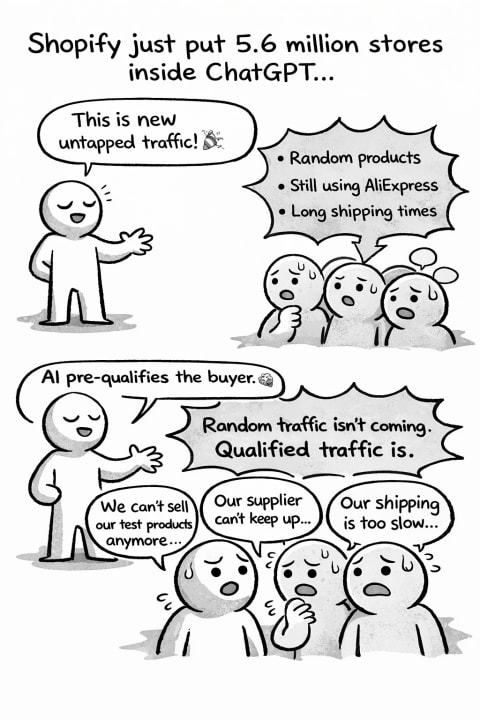
1) Inventory risk just went exponential
Before:
— Bad stock = a few angry customers
Now:
— AI recommends your product → thousands of people see it instantly
👉 If your supplier is slow or inaccurate:
— you can oversell at scale
— you can destroy your reviews overnight
One viral AI recommendation can break your entire backend.
2) Your “test products” are now liabilities
Most stores:
— dozens of random SKUs
— half-tested
— unclear positioning
AI doesn’t care.
It will surface them anyway.
👉 Meaning:
— your weakest products = highest risk exposure
— your catalog tail = your biggest vulnerability
3) You cannot hide from AI discovery
You can:
— disable checkout
— hide some products
But you cannot:
— fully opt out of being seen
👉 AI is now behaving like Google, not like a platform you can ignore
4) Bad data is worse than no data
AI reads:
— your title
— your description
— your structured data
Then decides:
— what your product is
— who it is for
— whether to recommend it
👉 If your listing is weak:
— AI will mis-sell your product
— conversions drop
— returns go up
🧠 The biggest insight (almost no one is talking about this)
AI traffic converts differently.
— AI traffic grew 7x
— AI orders grew 11x
👉 Orders grow faster than traffic
Why?
Because:
— AI pre-qualifies the buyer before they even click
Translation for dropshippers:
You don’t get:
— curiosity clicks
You get:
— expectation-driven buyers
Which means:
— your product must match expectation exactly
— your fulfillment must match promise exactly
⚠️ Where most dropshippers will fail
1) Still writing listings for humans
— short descriptions
— vague titles
— no structured data
👉 AI won’t understand your product properly
2) Treating this like “free traffic”
Yes, no 4% fee anymore.
But:
— competition exploded overnight
— 5.6 million stores entered instantly
👉 This is not early-stage arbitrage
👉 This is instant saturation
3) Ignoring fulfillment speed
AI buyers:
— convert faster
— expect faster delivery
If your model is:
— 10–15 day shipping from China
👉 You will get:
— worse reviews
— harsher expectations
— faster churn
4) Not controlling your catalog
Most dropshippers:
— upload everything
— test everything
Now:
— everything can be shown
👉 You need to curate what AI is allowed to see
🧩 What smart operators will do immediately
1) Clean your catalog
— remove weak SKUs
— hide unstable products
— focus on proven items
2) Rewrite titles for AI queries
Bad:
— “Blue Shirt XL”
Good:
— “Breathable cotton gym shirt for humid weather (men XL)”
👉 Think like a search query, not a product name
3) Fix descriptions
Your description should:
— explain use case
— handle objections
— define who it’s for
Because:
— AI uses it to sell for you
4) Tighten inventory buffers
Especially if:
— supplier latency is high
— stock updates are slow
👉 Inventory accuracy is now a growth lever, not ops detail
5) Align logistics with expectation
If AI drives:
— faster decision-making
You need:
— faster fulfillment
OR
— clearer delivery expectations
🔥 The real connection (this ties everything together)
Look at what’s happening at the same time:
— Amazon moving inventory upstream into China
— JD building global logistics infrastructure
— Shopify pushing AI-driven discovery
👉 These are not separate trends.
They are converging into one system:
— AI decides demand
— Logistics fulfills instantly
— Data determines who wins
Final thought
Dropshippers used to win by:
— finding products early
— running ads faster
Now?
You win by being the product AI chooses.
And AI doesn’t choose based on:
— hype
— luck
— “winning product” lists
It chooses based on:
— data clarity
— fulfillment reliability
— consistency
Most people will realise this too late.
The ones who move now will look “lucky” later.
On March 24, something quietly happened.
No announcement hype.
No “new feature” buzz.
But it may matter more than any ad strategy you’re running right now.
⚠️ 5.6 million stores just became “AI-native”
Shopify didn’t ask for permission.
They turned on Agentic Storefronts by default.
That means:
👉 Your store is already being surfaced inside AI
👉 Your products are already being recommended
👉 You are already competing there
Whether you prepared for it or not.
The shift most people are missing
This is not “another traffic channel”.
This is:
Discovery moving outside your store completely.
Before:
— Customer sees ad → clicks → lands on your product page
Now:
— Customer asks AI → AI chooses product → sends them to checkout
👉 Your product page is no longer the first impression
👉 Your data is
🧠 The uncomfortable truth
You are no longer competing as a store.
You are competing as:
— a data point
— inside a cluster
— inside a machine decision
Because Shopify Catalog:
— groups identical products
— compares sellers
— normalises listings
👉 Your product is not “yours” anymore
👉 It’s one option among many in an AI decision layer
🚨 Where dropshippers are actually exposed (this part is critical)
1) Inventory risk just went exponential
Before:
— Bad stock = a few angry customers
Now:
— AI recommends your product → thousands of people see it instantly
👉 If your supplier is slow or inaccurate:
— you can oversell at scale
— you can destroy your reviews overnight
One viral AI recommendation can break your entire backend.
2) Your “test products” are now liabilities
Most stores:
— dozens of random SKUs
— half-tested
— unclear positioning
AI doesn’t care.
It will surface them anyway.
👉 Meaning:
— your weakest products = highest risk exposure
— your catalog tail = your biggest vulnerability
3) You cannot hide from AI discovery
You can:
— disable checkout
— hide some products
But you cannot:
— fully opt out of being seen
👉 AI is now behaving like Google, not like a platform you can ignore
4) Bad data is worse than no data
AI reads:
— your title
— your description
— your structured data
Then decides:
— what your product is
— who it is for
— whether to recommend it
👉 If your listing is weak:
— AI will mis-sell your product
— conversions drop
— returns go up
🧠 The biggest insight (almost no one is talking about this)
AI traffic converts differently.
— AI traffic grew 7x
— AI orders grew 11x
👉 Orders grow faster than traffic
Why?
Because:
— AI pre-qualifies the buyer before they even click
Translation for dropshippers:
You don’t get:
— curiosity clicks
You get:
— expectation-driven buyers
Which means:
— your product must match expectation exactly
— your fulfillment must match promise exactly
⚠️ Where most dropshippers will fail
1) Still writing listings for humans
— short descriptions
— vague titles
— no structured data
👉 AI won’t understand your product properly
2) Treating this like “free traffic”
Yes, no 4% fee anymore.
But:
— competition exploded overnight
— 5.6 million stores entered instantly
👉 This is not early-stage arbitrage
👉 This is instant saturation
3) Ignoring fulfillment speed
AI buyers:
— convert faster
— expect faster delivery
If your model is:
— 10–15 day shipping from China
👉 You will get:
— worse reviews
— harsher expectations
— faster churn
4) Not controlling your catalog
Most dropshippers:
— upload everything
— test everything
Now:
— everything can be shown
👉 You need to curate what AI is allowed to see
🧩 What smart operators will do immediately
1) Clean your catalog
— remove weak SKUs
— hide unstable products
— focus on proven items
2) Rewrite titles for AI queries
Bad:
— “Blue Shirt XL”
Good:
— “Breathable cotton gym shirt for humid weather (men XL)”
👉 Think like a search query, not a product name
3) Fix descriptions
Your description should:
— explain use case
— handle objections
— define who it’s for
Because:
— AI uses it to sell for you
4) Tighten inventory buffers
Especially if:
— supplier latency is high
— stock updates are slow
👉 Inventory accuracy is now a growth lever, not ops detail
5) Align logistics with expectation
If AI drives:
— faster decision-making
You need:
— faster fulfillment
OR
— clearer delivery expectations
🔥 The real connection (this ties everything together)
Look at what’s happening at the same time:
— Amazon moving inventory upstream into China
— JD building global logistics infrastructure
— Shopify pushing AI-driven discovery
👉 These are not separate trends.
They are converging into one system:
— AI decides demand
— Logistics fulfills instantly
— Data determines who wins
Final thought
Dropshippers used to win by:
— finding products early
— running ads faster
Now?
You win by being the product AI chooses.
And AI doesn’t choose based on:
— hype
— luck
— “winning product” lists
It chooses based on:
— data clarity
— fulfillment reliability
— consistency
Most people will realise this too late.
The ones who move now will look “lucky” later.
0
0